Local SEO Tips for Small Business Owners in India
What You’ll Learn in This Guide
- What local SEO is and why it is non-negotiable for Indian small businesses today
- How to set up and optimise your Google Business Profile from scratch
- The role of NAP consistency, local citations, and Indian directories
- Proven strategies including voice search, hyperlocal content, and schema markup
- The most common local SEO mistakes and exactly how to fix them
- How to measure ROI and track your local SEO performance with free tools
Understanding Local SEO and Its Importance for Indian Small Businesses
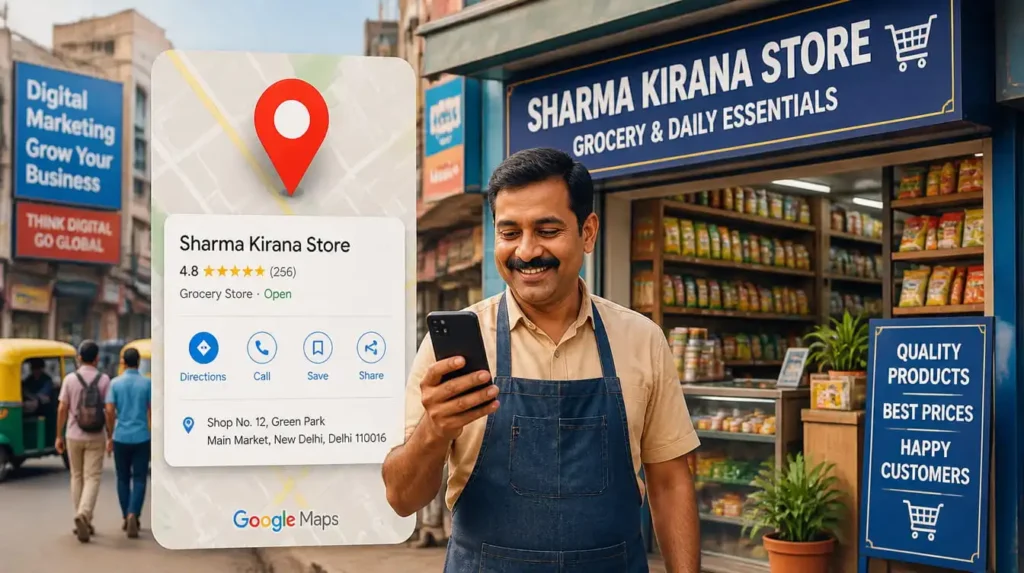
Picture this: A customer in Pune is standing on a street corner, hungry, and types “best thali near me” into Google. In less than three seconds, Google shows three restaurants on a map at the very top of the screen — complete with star ratings, opening hours, phone numbers, and directions. That coveted strip of three businesses is called the Local Pack or the Google 3-Map Pack. If your restaurant is one of them, your phone rings. If it is not, a competitor’s phone rings instead.
This is the reality of doing business in India today. Millions of potential customers are searching for exactly what you offer, right in your neighbourhood, right now. The question is not whether they are searching — they are. The question is whether they are finding you.
So, What Exactly Is Local SEO?
Local SEO (Local Search Engine Optimisation) is the practice of improving your business’s visibility in geographically relevant online search results. Unlike traditional SEO — which focuses on ranking your website for broad, national-level keywords — local SEO targets location-specific queries. When someone searches for “plumber in Bengaluru” or “affordable CA near me in Delhi,” local SEO determines whether your business appears in those results.
Local SEO encompasses a cluster of activities: optimising your Google Business Profile, maintaining consistent business information across the web, collecting genuine customer reviews, building citations on local directories, creating location-specific content on your website, and implementing structured data markup so search engines understand exactly who you are and where you operate.
Why Local SEO Is Critical Specifically for India
India is not just a large market — it is a hyper-local one. When someone in Jaipur needs a dentist, they are not interested in a clinic in Chennai. When a factory owner in Surat needs a raw material supplier, they want someone in their district, not Delhi. Indian consumers have always been community-driven buyers. Local SEO is simply the digital version of that age-old Indian reality: trust the business around the corner.
📊 Local SEO by the Numbers — India & Global
Sources: BrightLocal Local SEO Statistics 2026, Digital Applied, Arcenik Technologies, upGrowth
India saw a 12% year-on-year growth in new Google Business Profile registrations in recent years, fuelled by government MSME digital initiatives. Yet despite this growth, only 35% of small businesses have a Google Business Profile, and many of those that do have incomplete or unoptimised listings. This means the opportunity is enormous: by doing the basics correctly, you can leapfrog the majority of your local competitors almost immediately.
Local SEO vs. Regular SEO: Understanding the Difference
This is a question many Indian small business owners ask: If I already have a website, is that not enough? Having a website is a great start, but a website alone does not guarantee that local customers find you. Here is a simple comparison to clarify the difference:
| Feature | Regular SEO | Local SEO |
|---|---|---|
| Target Audience | National or global visitors | Nearby customers in a specific city or area |
| Key Ranking Tool | Website content & backlinks | Google Business Profile + reviews + citations |
| Primary Result Type | Blue link organic results | Local Pack (Map + 3 listings) + organic |
| Timeline to Results | 6–18 months typically | 4–8 weeks for initial gains |
| Purchase Intent | Varies — often informational | Very high — searchers are ready to buy or visit |
| Best for | Ecommerce, SaaS, publishers | Restaurants, clinics, shops, service businesses |
The good news: most Indian small businesses need both, and the work you do for local SEO directly strengthens your overall SEO as well. Think of them as two sides of the same coin.
Effective Local SEO Strategies for Indian Small Businesses
Now that you understand what local SEO is and why it matters, let’s get into the practical strategies you can implement right now. These are not theoretical concepts — they are concrete, actionable steps that have been proven to move the needle for small businesses across India, from Tier-1 metros to Tier-3 towns.
Strategy 1: Claim, Verify, and Fully Optimise Your Google Business Profile
If local SEO is a building, your Google Business Profile (GBP) is its foundation. According to the Whitespark Local Search Ranking Factors Survey, GBP signals account for 32% of local ranking weight — making it the single most impactful asset you can control. And yet, more than half of Indian small businesses have either not claimed their profile or have left it woefully incomplete.
A complete, active Google Business Profile is essentially a free storefront on the world’s most used search engine. It shows up in Google Search and Google Maps, displaying your address, hours, phone number, photos, reviews, and even your products or services — all before a potential customer even clicks through to your website.
📋 How To: Set Up Your Google Business Profile Step-by-Step
- Go to business.google.com and sign in with a Google account you control.
- Search for your business name. If it already exists (perhaps added by a customer), claim it. If not, create a new listing.
- Choose your primary business category carefully. This is a critical relevance signal. For example, if you run a dental clinic, select “Dentist” not just “Healthcare.” You can add secondary categories too.
- Enter your exact address as it appears on your signboard and legal documents. Service-area businesses (like plumbers or tutors who visit clients) can hide their address and list their service areas instead.
- Add your business phone number — preferably a local landline or the primary mobile you always answer.
- Set accurate business hours, including special hours for festivals and public holidays.
- Write a compelling business description of up to 750 characters. Include your main services, your location, and 2–3 natural mentions of keywords your customers would search for.
- Add at least 10 high-quality photos: your shopfront, interior, products, team, and a logo. Profile photos are the most influential factor customers consider when choosing a business.
- List all your services or products with descriptions and prices where applicable.
- Complete verification via postcard, phone, or video as Google directs. Your listing will not rank until verification is complete.
- Publish your first Google Post — an update, offer, or event. Make this a weekly habit.
Once live, your GBP is not a “set it and forget it” asset. Google rewards active profiles. Businesses that post weekly updates, respond to every review, add new photos monthly, and keep their information current consistently outrank those with dormant profiles — even if the dormant profiles have more reviews.
Strategy 2: Master NAP Consistency — The Overlooked Foundation
NAP stands for Name, Address, and Phone Number — the three core identity elements of your business online. NAP consistency means that every single time your business is mentioned on the internet, these three pieces of information are spelled, formatted, and punctuated in exactly the same way.
This might sound trivially simple, but it is one of the most commonly broken rules in local SEO. If your Google Business Profile says “Sharma Electronics, 24 MG Road, Bengaluru – 560001” but your JustDial listing says “Sharma Electronics Pvt Ltd, MG Road, Bangalore”, Google sees two potentially different businesses. This inconsistency dilutes your trust signals and directly suppresses your rankings.
NAP Consistency — What It Looks Like in Practice:
❌ Inconsistent (Harmful)
Website: Sharma Electronics Pvt Ltd
JustDial: Sharma Electronics
Google: Sharma Electronics Co.
Sulekha: Sharma Elect.
✅ Consistent (Correct)
Website: Sharma Electronics Pvt Ltd
JustDial: Sharma Electronics Pvt Ltd
Google: Sharma Electronics Pvt Ltd
Sulekha: Sharma Electronics Pvt Ltd
Even minor differences — “Road” vs “Rd.”, “+91” prefix on the phone number vs without — can create confusion for search engine crawlers and reduce your ranking authority.
The impact of fixing NAP consistency is measurable and significant. Businesses with consistent NAP information across 75% or more of major directories see up to a 186% increase in website clicks from Google. Citation consistency also carries an estimated 35% weight factor in local map pack rankings — making it one of the highest-leverage fixes you can make.
The Top Indian Directories Where Your NAP Must Appear
International tools like Yelp carry less weight in India. For Indian businesses, these are the directories that matter most for local authority:
| Directory | Best For | Authority | Free Listing? |
|---|---|---|---|
| Google Business Profile | All businesses | ⭐⭐⭐⭐⭐ | Yes |
| JustDial | All local businesses | ⭐⭐⭐⭐⭐ | Yes (basic) |
| Sulekha | Services, Home, Events | ⭐⭐⭐⭐ | Yes |
| IndiaMART | B2B, Manufacturing, Wholesale | ⭐⭐⭐⭐⭐ | Yes (basic) |
| TradeIndia | B2B, Traders, Suppliers | ⭐⭐⭐⭐ | Yes |
| Yellow Pages India | General business listings | ⭐⭐⭐ | Yes |
| Practo | Healthcare, Clinics, Doctors | ⭐⭐⭐⭐⭐ | Yes |
| Housing.com | Real Estate Agents | ⭐⭐⭐⭐ | Yes |
| Urban Company | Home Services | ⭐⭐⭐⭐ | Partner program |
| Bing Places | All businesses | ⭐⭐⭐ | Yes |
Strategy 3: Build and Manage Online Reviews Systematically
Online reviews are simultaneously a ranking signal and a conversion factor. They influence whether Google shows you in the Local Pack, and they influence whether a customer chooses to call you once they see you. Today, 87% of consumers read online reviews before choosing a local business, and businesses with fewer than 10 reviews or an average rating below 4.0 stars face a measurable drop in conversions.
Google’s local ranking algorithm evaluates reviews along three dimensions:
- Quantity: The total number of reviews. More reviews generally mean higher ranking, as they signal that real customers are transacting with your business.
- Recency: A business that received 5 reviews last week is treated as more active and relevant than one with 50 reviews from three years ago.
- Keywords in reviews: When customers naturally mention your services in their reviews — e.g., “fantastic AC repair service in Hyderabad” — those keywords actually contribute to your ranking for those terms.
How to Get More Reviews Without Violating Google’s Guidelines
The right approach is to build a consistent, organic system for asking satisfied customers to leave reviews. Here is what works:
- Ask at the right moment. The best time to request a review is immediately after a positive interaction — when a customer completes a purchase, thanks you for a service, or expresses satisfaction. That emotional window is your best opportunity.
- Make it easy. Generate your Google review link from your GBP dashboard and share it via WhatsApp, SMS, or email. The fewer steps between intention and action, the higher your conversion rate.
- Train your team. Every customer-facing staff member should be comfortable asking for a review as part of their closing script. A simple “If you are happy with our service, it would really help us if you left a Google review” goes a long way.
- Respond to every single review. When you respond to reviews — both positive and negative — it signals to Google that your business is active and engaged. More importantly, it signals to potential customers that you care. Businesses that respond to reviews consistently outrank those that do not.
Strategy 4: Optimise Your Website for Local Intent
Your website is the backbone that supports everything else you do in local SEO. Even if a customer finds you on Google Maps, many will visit your website before calling or visiting. A poorly optimised website not only loses customers — it also weakens your Google Business Profile’s authority.
Essential On-Page Local SEO Tactics
- Title Tags & Meta Descriptions with City Names: Every key page should include your target city. For example, instead of “Plumbing Services”, use “Plumbing Services in Pune | Fast, Reliable, Affordable”. These signals tell Google exactly which geography your page is relevant for.
- Create Dedicated Location Pages: If you serve multiple areas — say, both Andheri and Borivali in Mumbai — create a separate, unique page for each location with at least 400 words of genuinely different content about that area. Do not simply copy-paste the same page with only the city name swapped. Google penalises thin, duplicate content.
- Embed a Google Map on Your Contact Page: This is a simple but effective trust signal. Embedding your exact GBP location on your contact page reinforces your location data for both users and search engines.
- Mobile-First Design: Over 70% of Indian internet traffic comes from mobile devices. If your website is slow or difficult to navigate on a smartphone, customers will leave, and Google will rank you lower. Test your site with Google’s PageSpeed Insights and fix any issues flagged.
- Use Schema Markup (Structured Data): Add
LocalBusinessschema to your website’s code. This structured data tells Google your business type, name, address, phone, hours, and service area in a language search engines can read perfectly. You can use Google’s Structured Data Markup Helper tool to generate the code without needing deep technical knowledge.
For WordPress websites, plugins like Yoast SEO (which Inspired Monks uses, as reflected in our sitemap structure) and Rank Math make implementing schema markup and optimising meta tags straightforward — no coding required. If you would like help setting up your WordPress site for local SEO, our web development services include full on-page optimisation as part of every project.
Strategy 5: Create Hyperlocal Content That Serves Your Community
Content is still king — but in local SEO, the keyword is localised content. Google’s helpful content guidelines reward businesses that create genuinely useful, specific content for their community. For an Indian small business, this translates into a content strategy that speaks directly to the needs, context, and language of your local customers.
Here are hyperlocal content ideas with real examples:
- “Near Me” Blog Posts: Write articles like “Best Tax Consultants in Rajkot: What to Look for in a CA” or “Top 5 Questions to Ask Before Hiring an Interior Designer in Kochi.” These long-tail searches are less competitive and highly targeted.
- Local Event Coverage: If there is a trade fair, festival, or community event in your area, write about it. Link it to your business contextually. This builds local relevance and earns you backlinks from local news sites and community blogs.
- Hindi, Hinglish, or Regional Language Content: India is a multilingual country. If your target customers in Varanasi or Indore predominantly search in Hindi or use Hinglish voice queries, even one or two pages of content in their language can dramatically improve your local visibility. 45% of Indian searches are voice-initiated, and the majority of those voice queries are in regional languages or Hinglish — not formal English.
- FAQ Pages Targeting Conversational Queries: Voice search queries are conversational. Think about how someone would ask a question aloud: “Kya aap Sunday ko open hain?” or “What is the price of a full body checkup in Nagpur?” Build FAQ sections that answer these questions naturally.
Strategy 6: Leverage India-Specific Digital Touchpoints
The Indian digital ecosystem has unique platforms that your competitors — especially those following generic Western SEO advice — may be ignoring entirely. These represent genuine local SEO opportunities:
- WhatsApp Business: India has over 530 million WhatsApp users. Set up a WhatsApp Business profile with your full business information, working hours, and a product catalogue. Your WhatsApp number should match the one on your GBP listing (NAP consistency). Share your Google review link via WhatsApp as a follow-up after transactions.
- Google Pay & PhonePe Business Listings: These UPI payment apps show nearby businesses to users. Getting listed as an accepted merchant improves foot traffic visibility for retail and food businesses, especially in Tier-2 and Tier-3 cities where UPI usage is growing fastest.
- AI Overviews Optimisation: Google’s AI Overview (formerly Search Generative Experience) increasingly pulls local business information into conversational AI answers. Businesses with strong reviews, complete GBP profiles, and FAQ-rich websites are more likely to be cited in these AI-generated responses. This is a rapidly growing traffic channel.
Need Help With Your Website?
Get a Local SEO-Ready Website Built by Experts
At Inspired Monks, we build fast, mobile-first WordPress websites fully optimised for local search — with schema markup, on-page SEO, and Google Business Profile integration built in from day one.
Common Local SEO Mistakes Indian Small Businesses Must Avoid
Understanding what to do is only half the battle. Knowing what not to do can save you months of lost rankings and missed customers. These are the most damaging local SEO mistakes made by Indian small businesses, with real-world implications for each.
Mistake 1: Unclaimed or Incomplete Google Business Profile
This is the number-one mistake. Many Indian business owners either do not know their GBP exists or have left it with default information. Some have never even heard of it. An unclaimed profile is dangerous: it may contain incorrect information added by well-meaning customers or Google’s automated systems, and you have no ability to correct it or respond to reviews.
Real-world impact: A medical clinic in Bengaluru found that their unclaimed GBP was showing outdated opening hours from two years prior. Dozens of patients had been arriving to find the clinic closed, leaving one-star reviews explaining their frustration. The clinic had no idea until they finally claimed their profile and saw the damage. Months of one-star reviews had buried their ranking well below competitors.
Mistake 2: Inconsistent or Missing NAP Across Directories
As covered in Strategy 2, NAP inconsistency is one of the most pervasive and damaging mistakes in local SEO. It is especially common in India because businesses often have multiple phone numbers (personal mobile + business line), change addresses when moving premises, or get listed under slightly different names by different directories over time.
Real-world impact: A hardware shop in Pune had three different phone numbers listed across JustDial, Sulekha, and their own website — one was an old number no longer in use. Google’s local algorithm, unable to reconcile the conflicting information, significantly reduced their Local Pack appearance. After a full NAP audit and cleanup, their direction requests from Google Maps increased by over 60% within two months.
Mistake 3: Ignoring or Mishandling Online Reviews
Many business owners make two opposite errors: either they ignore reviews entirely, or they respond to negative reviews with anger and defensiveness. Both destroy your local SEO performance and your reputation.
Ignoring reviews signals to Google that your business is inactive and unresponsive to customers. Responding defensively to a negative review — particularly in a way that is argumentative or dismissive — damages trust with every potential customer who reads it. Potential customers read your responses just as carefully as they read the reviews themselves.
Real-world impact: A restaurant in Delhi received a negative review from a customer who complained about slow service. The owner responded publicly with accusations and insults, calling the reviewer dishonest. This response received more attention than the original review, went viral on local social media, and resulted in a wave of additional negative reviews from people who had not even visited the restaurant.
The right approach: Respond to every negative review calmly, professionally, and empathetically. Acknowledge the experience, apologise sincerely, and invite the customer to contact you directly to resolve the issue. This converts a public dispute into a private conversation and demonstrates to other readers that you take customer satisfaction seriously.
Mistake 4: A Website That Is Not Mobile-Optimised
In India, the smartphone is the internet for the majority of users. If your website takes more than 3 seconds to load on a 4G connection, roughly 53% of mobile visitors will abandon it. If the text is too small to read without zooming, if buttons are too close together to tap accurately, or if the layout breaks on smaller screens, you are losing customers and rankings simultaneously.
Google uses a mobile-first indexing approach, which means it primarily uses the mobile version of your website to determine your ranking — even for desktop searches. A site that is beautifully designed on desktop but broken on mobile will rank as if it is broken, full stop.
Mistake 5: Keyword Stuffing in Your Business Name or Description
One of the oldest black-hat tricks is adding keywords to your Google Business Profile name — for example, registering your business as “Sharma Electronics — Best TV Shop Cheap Price Bengaluru” when your actual registered name is simply “Sharma Electronics.” Google is very clear that this violates their guidelines, and businesses caught doing it risk having their profile suspended entirely.
The same applies to your website content and meta descriptions. Repeating “best plumber in Mumbai” twenty times on a single page does not help — it actively triggers spam filters and hurts your ranking. Natural, contextual language wins every time.
Mistake 6: Neglecting Schema Markup
Schema markup (also called structured data) is a code layer that tells search engines exactly what your business is, where it is, what it does, and what your customers say about it. Despite its importance, a large proportion of Indian small business websites have no schema markup at all.
Without schema, Google has to guess this information by reading your web pages the same way a human would — and it sometimes guesses wrong. With proper LocalBusiness schema, you eliminate that guesswork, making it far easier for Google to surface your business in the right local searches. You also become eligible for rich results like star ratings appearing directly in search results, which significantly increase click-through rates.
| Mistake | Ranking Impact | Fix Difficulty |
|---|---|---|
| Unclaimed / incomplete GBP | 🔴 Severe | Easy — 30 minutes |
| Inconsistent NAP | 🔴 Severe | Medium — audit + cleanup |
| No reviews / poor review management | 🟠 High | Ongoing effort |
| Non-mobile-optimised website | 🔴 Severe | Medium — redesign needed |
| Keyword stuffing | 🟠 High (+ penalty risk) | Easy — edit content |
| No schema markup | 🟡 Moderate | Medium — plugin or dev work |
| No localised content | 🟡 Moderate | Ongoing content creation |
Measuring the Success and ROI of Your Local SEO Efforts
One of the most common frustrations business owners express is the feeling that SEO is invisible — you invest time and money, but you cannot tell what is working. This is a solvable problem. With the right tracking systems in place, your local SEO performance becomes entirely measurable and attributable to real business outcomes.
The important context to understand first: local SEO delivers an average ROI of approximately 700% within 6–12 months for service-based businesses. That is not a typo. For the median business investing ₹12,000–₹15,000 per month in local SEO (including tools, content, and professional help), this translates into attributable monthly revenue far exceeding that investment by month six. The returns compound over time because organic rankings, unlike paid advertising, do not vanish the moment you stop paying.
The Key Metrics to Track
Not all metrics are created equal. Many local SEO reports dazzle clients with impressive-looking charts of keyword impressions and average position — numbers that look great but do not directly connect to revenue. Focus on the metrics that actually matter for your business:
📞 Calls from Google Business Profile
Tracked directly in GBP Insights. This is the most direct revenue signal — a phone call from a local search is almost always a purchase-intent action. Track this monthly and watch for growth trends.
🗺️ Direction Requests
Tracked in GBP Insights. Every direction request is a potential physical visit to your premises. A growing number of direction requests is one of the clearest signals that your local visibility is improving.
🔍 Local Keyword Rankings
Use Google Search Console (free) to track your ranking positions for location-specific keywords. Focus on “service + city” queries like “CA firm Surat” or “LED TV shop Lucknow.” Rank tracking tools like BrightLocal or Whitespark give more granular local ranking data.
🌐 Organic Traffic from Local Pages
Tracked in Google Analytics 4 (GA4). Filter your organic search traffic by landing page to see how many visitors are landing on your location pages or service pages. Track conversion events (form submissions, click-to-call) from these pages specifically.
⭐ Review Volume and Average Rating
Track your total review count and average star rating monthly. A consistently growing review count and stable rating above 4.0 are both direct ranking inputs and conversion rate drivers. Set a monthly review target (e.g., 5 new reviews per month) and track progress.
The Free Tool Stack for Indian Small Businesses
You do not need to invest in expensive software to track your local SEO performance effectively. The following free tools provide everything a small Indian business needs to get started:
| Tool | What It Measures | Cost | Setup Difficulty |
|---|---|---|---|
| Google Business Profile Insights | Calls, directions, views, photo views | Free | None — already in GBP |
| Google Search Console | Keyword rankings, impressions, clicks | Free | Low — 15 minutes to set up |
| Google Analytics 4 (GA4) | Traffic, conversions, user behaviour | Free | Medium — requires configuration |
| Google PageSpeed Insights | Site speed, Core Web Vitals | Free | None — just enter your URL |
| Moz Local (Free Audit) | NAP consistency audit across directories | Free audit | None |
| Google Rich Results Test | Schema markup validation | Free | None — just enter your URL |
How to Build a Simple Monthly Reporting Routine
Measuring local SEO does not require hours of analysis. Build a simple monthly tracking habit using this framework:
📅 Monthly Local SEO Review Checklist
- ✅ Log GBP Insights: note calls, direction requests, and website clicks vs. prior month
- ✅ Check Search Console: review impressions and clicks for top 10 local keywords
- ✅ Count new reviews received and update average rating record
- ✅ Confirm all key pages still load correctly on mobile (random spot check)
- ✅ Review any new citations added or corrected that month
- ✅ Check if any new local competitors have appeared in the Local Pack for your main keywords
- ✅ Publish at least one new piece of local content (blog post, GBP post, or FAQ update)
- ✅ Note the one action that will have the highest impact next month
What ROI Can You Realistically Expect?
Expectations matter in any marketing investment. Local SEO is not instant — but its return curve is powerful. Here is a realistic timeline for an Indian small business investing consistently in local SEO:
Weeks 1–4: Foundation Phase
Claim and fully optimise GBP. Fix NAP inconsistencies. Verify and clean up directory listings. Set up Google Search Console and GA4. Expected early wins: Profile views increase; you may start appearing in Local Pack for your business name.
Months 2–3: Growth Phase
Reviews start accumulating. New location pages are indexed. Schema markup implemented. Regular GBP posts established. Expected results: Appearing in Local Pack for service + city queries. Measurable increase in calls and direction requests.
Months 4–6: Compounding Phase
Local authority builds. Content earns backlinks from local sites. Review count crosses 30+. AI Overview citations begin appearing for some queries. Expected results: Consistent top-3 Local Pack presence for main queries. Measurable revenue attribution. ROI turning clearly positive.
Month 6 and Beyond: Dominance Phase
Strong competitive moat established through review volume, citation authority, and content depth. Expected results: Dominant Local Pack presence. Organic traffic driving consistent conversions. Average ROI of 700%+ being realised for service businesses.
The key insight is that unlike pay-per-click advertising — which stops delivering the moment your budget is exhausted — the authority you build through local SEO compounds. A Google Business Profile with 100 genuine reviews and a three-year history of consistent updates cannot be easily displaced by a new competitor next month. You are building a moat, not renting attention.
Local SEO and Your WordPress Website
If your business website is built on WordPress — which powers over 43% of all websites globally and is the platform of choice for most Indian small business sites — you have a significant advantage in implementing local SEO. WordPress’s flexibility and the ecosystem of SEO plugins make it possible to implement most of the strategies covered in this guide without writing a single line of code.
Here are the key elements to have in place on your WordPress site for maximum local SEO impact:
- Yoast SEO or Rank Math Plugin: These plugins handle title tags, meta descriptions, sitemaps, and basic schema markup. Both have free tiers that cover 90% of what a small business needs. We use Yoast SEO here at Inspired Monks across our projects.
- Speed Optimisation: Slow WordPress sites kill local rankings. Implement a caching plugin (WP Rocket or W3 Total Cache), use a lightweight theme, compress images, and use a CDN. Our guide on WordPress speed optimisation covers every step in detail.
- Security Headers: Google factors website security into its ranking signals. Properly configured HTTP security headers protect your site from attacks and signal trustworthiness to search engines. Our HTTP Security Header Scanner can instantly assess your site’s security posture.
- Core Web Vitals: Google’s user experience metrics — Largest Contentful Paint, Interaction to Next Paint, and Cumulative Layout Shift — directly influence both organic and local rankings. Our Core Web Vitals guide for WordPress provides a complete optimisation roadmap.
- Local Schema via Plugin: Rank Math’s local SEO module generates
LocalBusinessschema automatically from a simple form interface, with no coding required.
Need an expert to build or optimise your WordPress site for local SEO from the ground up? Our web development services are specifically designed for Indian small businesses and startups — and we build with local SEO in mind from the first line of code.
Free Proposal
Get a Custom Local SEO Proposal for Your Business
Tell us about your business and we’ll create a tailored local SEO strategy — including a free audit of your current online presence.
Local SEO Ranking Factors: What Google Weighs Most
Google uses three primary categories of signals to determine which businesses appear in the Local Pack — and in what order. Understanding these categories helps you prioritise your efforts correctly.
Relevance
How well your business matches what the searcher is looking for. Driven by: business category, keywords in your GBP description and services, website content, and on-page signals.
Proximity
How close your business is to the searcher or the location they specified. You cannot change your physical location — but you can ensure your service area is properly defined in GBP.
Prominence
How well-known and trusted your business is, both online and offline. Driven by: review count and quality, citation volume, website authority, backlinks, and brand mentions across the web.
Of these three, relevance and prominence are within your direct control. Proximity is a fixed physical reality — though service-area businesses have flexibility by defining the geographic areas they serve. The practical implication: if you are losing to a competitor who is physically closer to searchers, your path to overtaking them is through superior prominence and relevance signals — more reviews, better content, stronger citations, and a more complete GBP profile.
📌 Complete Guide Summary — Save This
✅ What to Do (Strategy)
- Claim + fully optimise your GBP
- Fix NAP consistency everywhere
- Build reviews systematically
- List on JustDial, Sulekha, IndiaMART
- Optimise website for mobile + local keywords
- Add LocalBusiness schema markup
- Create hyperlocal, Hinglish-friendly content
- Post weekly GBP updates
❌ What to Avoid (Mistakes)
- Leaving GBP unclaimed or incomplete
- Inconsistent business name / address
- Ignoring or mishandling reviews
- Non-mobile-friendly website
- Keyword stuffing in GBP name
- Copy-paste location pages
- Buying fake reviews
- Ignoring voice search queries
📊 What to Measure (ROI)
- GBP calls + direction requests
- Local keyword rankings (Search Console)
- Organic traffic to location pages (GA4)
- Review count + average rating
- Website click-to-call conversions
- Monthly lead volume from local search
Frequently Asked Questions About Local SEO in India
Ready to Dominate Local Search in Your City?
Inspired Monks specialises in building high-performance, SEO-ready websites for Indian small businesses and startups. From Google Business Profile setup to full website development — we do it all.
